


On this page 6 sections
OpenAI says an unreleased AI model found 948 separate Linux kernel bugs in a single run in mid-October 2026. Each one could let an ordinary user account take full control of a machine. Most aren't fixed yet, so if you run Linux on a laptop, a server or a shared computer, the practical answer is simple: install kernel updates as soon as your distro ships them, and reboot.
The research, titled A thousand fewer paths to root, was published by OpenAI on 4 November 2026. Here's what this OpenAI Linux kernel bug discovery shows, what it doesn't, and what you should do about it.
What OpenAI's AI found in the Linux kernel
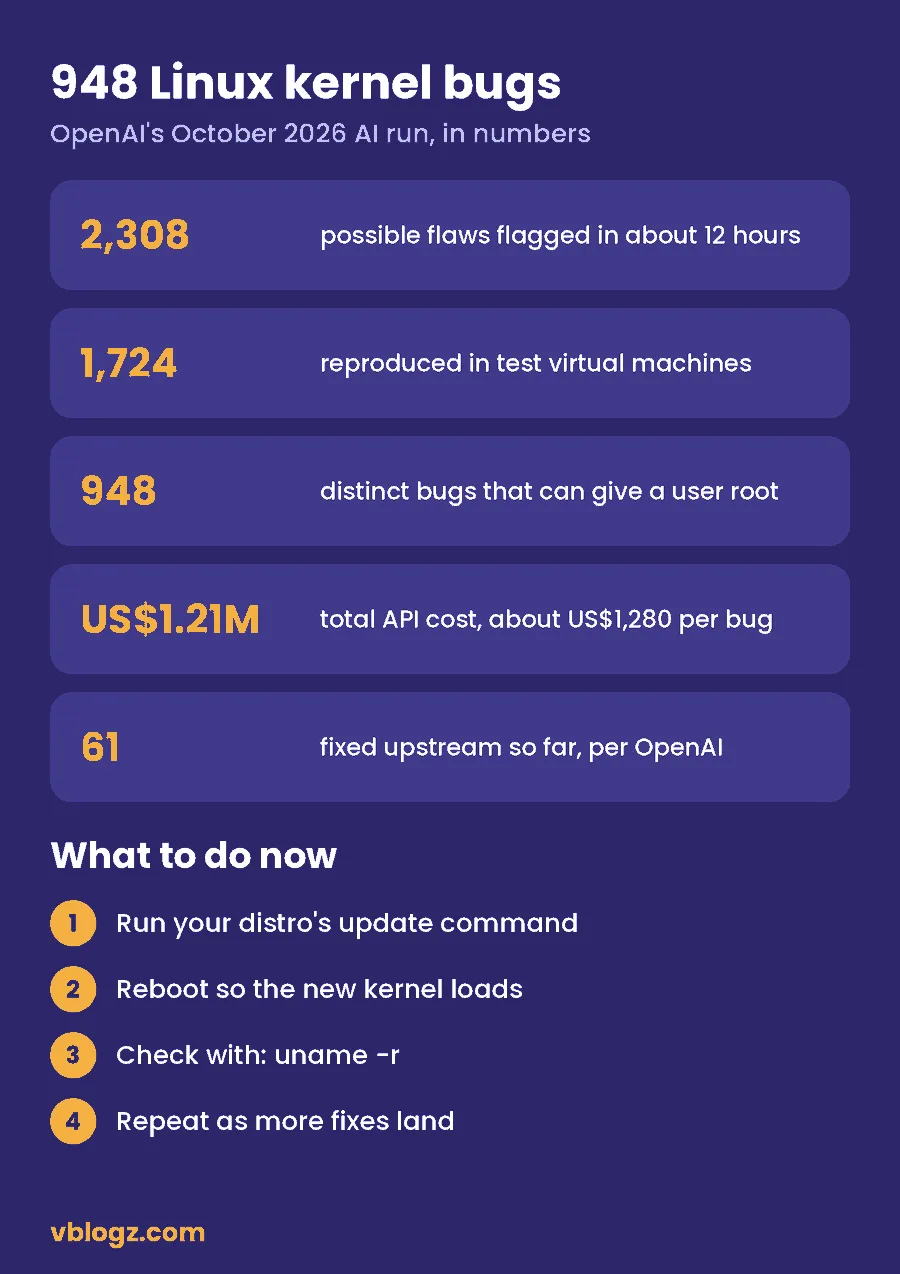
- 2,308 possible flaws flagged in about 12 hours
- 1,724 of them reproduced in test virtual machines
- 948 distinct privilege-escalation bugs after duplicates and variants were grouped
- About US$1.21 million in API costs, roughly US$1,280 per bug
The AI agents looked at around 2.8 million lines of kernel code that normal users can reach. That's only about 7% of the whole kernel. The full run, including human review, took about 10 days.
The exploit agents worked against a kernel with the usual protections switched on (SMEP, SMAP, KASLR and hardened usercopy), set up like a stock desktop Linux install. So these aren't tricks that only work on a stripped-down lab machine.
OpenAI hasn't named the model. It describes it only as an upcoming cybersecurity model and hasn't said who will get access to it.
The speed-up is what has security people talking. A July run with GPT-5.6 Sol found 166 unique bugs for US$513,690, about US$3,100 each. Three months later, the new model found more than five times as many at less than half the cost per bug, according to iTnews.
What "privilege escalation" means in plain words
A local privilege escalation (LPE) bug lets someone who already has a normal account on a computer turn it into an administrator account, called "root" on Linux. Root can read every file, install anything and hide what it's doing.
The key word is local. An attacker needs a way in first: a stolen login, a bad app or script you ran, or a weak website or service on the machine. These bugs don't let a stranger break into your laptop over the internet by themselves.
That's why OpenAI's warning is aimed mostly at servers and shared systems. It says that, for now, a low-privileged account on an unpatched system should be treated as "functionally equivalent to root access" for a well-funded attacker.
Who is affected and how worried you should be
OpenAI didn't name a distribution or kernel versions, so assume any Linux system that hasn't had recent kernel updates is in scope. How much it matters depends on who else can run code on the machine.
| Your setup | Risk level | What to do |
|---|---|---|
| Home Linux laptop or desktop, only you log in | Low to moderate. Someone has to run code on it first | Turn on automatic updates and reboot after kernel updates |
| Shared computers (labs, family PCs with several accounts) | Higher. Any user could become root | Patch quickly and remove accounts nobody uses |
| Web servers and VPS | Higher. A hacked site or plugin gives the first foothold | Patch, reboot or live-patch, and review who has shell access |
| Containers and CI runners running other people's code | Highest | Don't rely on the kernel alone. OpenAI suggests sandboxes such as gVisor or Firecracker |
| Android phones and Chromebooks | Unclear. Both run on the Linux kernel, but OpenAI hasn't said whether these bugs apply | Install monthly security updates when they arrive |
If you're on a phone and something already feels off, our guide on how to check if your phone is hacked walks through the signs and what to do.
How to update the Linux kernel on your system
Run your distro's update command, then restart. A new kernel isn't used until you reboot, unless you use a live-patching service.
- Check your current kernel version:
uname -r - Ubuntu, Debian, Linux Mint and Pop!_OS:
sudo apt update && sudo apt full-upgrade - Fedora:
sudo dnf upgrade --refresh - Arch Linux and Manjaro:
sudo pacman -Syu - openSUSE Tumbleweed:
sudo zypper dup(on Leap, usesudo zypper update) - Reboot, then run
uname -ragain to confirm the version changed.
On servers you can't restart easily, live-patching tools from the distro vendors, such as Canonical Livepatch on Ubuntu or kpatch on Red Hat Enterprise Linux, can apply some kernel fixes without a reboot.
One honest catch: as of 6 November 2026, most of the 948 bugs aren't fixed upstream. OpenAI's write-up says 61 had been patched upstream, 43 had patches waiting in staging and 299 were being discussed publicly. Updating today closes what has been fixed so far. You'll want to keep updating over the next few weeks as more fixes land.
If nobody else uses your home Linux machine, automatic updates plus a reboot now and then is enough. You don't need to do anything drastic.
Running Windows on another PC? The same rule applies there. See how to get free Windows 10 security updates to 2027 and what to check about the Secure Boot certificate expiry.
What this means for AI and security
Finding kernel bugs isn't new. The price is. At roughly US$1,280 a bug, an AI pipeline now does in days what used to take skilled people months.
OpenAI compared the haul with past prize money from hacking contests such as Pwn2Own and TyphoonPWN and put its notional value at US$18.9 million to US$66.3 million. Nobody was paid that. It's an illustration, and Hardware Busters calls the comparison rough at best.
This cuts both ways. Defenders get fixes faster. But OpenAI also expects that within a few years even weaker AI models could turn a publicly disclosed bug into a working attack. The gap between "fix published" and "attackers using it" is shrinking, which makes slow patching riskier than it used to be.
There are limits to what's been shown. Parts of the work can't be checked independently yet. OpenAI is holding back details of at least 10 exploitation techniques it says are new, for safety reasons. And the patches it sent to kernel maintainers are machine-written candidates that passed human review, not finished code merged into Linux.
OpenAI says it's reporting the bugs to kernel maintainers under the community's disclosure rules and releasing more findings gradually through partners in a programme it calls Patch the Planet.
Frequently asked questions
What did OpenAI's AI find in the Linux kernel?
In a mid-October 2026 run, OpenAI's AI agents found 948 distinct local privilege-escalation bugs in the Linux kernel. Each could let a normal user become root. The run cost about US$1.21 million in API credits.
Can these Linux bugs be used to hack my computer remotely?
Not on their own. They are local bugs, so an attacker first needs some access to the machine, such as a user account or a malicious program you ran. That's why shared machines and servers face more risk than a personal laptop.
Is Android affected by the OpenAI Linux kernel bugs?
OpenAI hasn't said. Android and ChromeOS use the Linux kernel, but there's no public list of which findings apply to them. Install your phone's monthly security updates, since that's how kernel fixes reach Android devices.
Which AI model did OpenAI use to find the bugs?
OpenAI describes it only as an upcoming cybersecurity model. It hasn't named it or said who will get access. An earlier July run used GPT-5.6 Sol and found 166 bugs.
How do I check my Linux kernel version?
Open a terminal and type uname -r. Run it again after updating and rebooting to make sure the new kernel is the one in use.













Comments 0
No comments yet. Start the conversation.