

On this page 8 sections
On 16 November 2026, malicious JavaScript was served to visitors of 178 organisations through Optimizely, a website testing platform, for about 16 hours. If you used a card or copied a crypto wallet address on an affected site that day, replace the card and check wallet addresses on a hardware wallet screen. iPhone and iPad users should update iOS now.
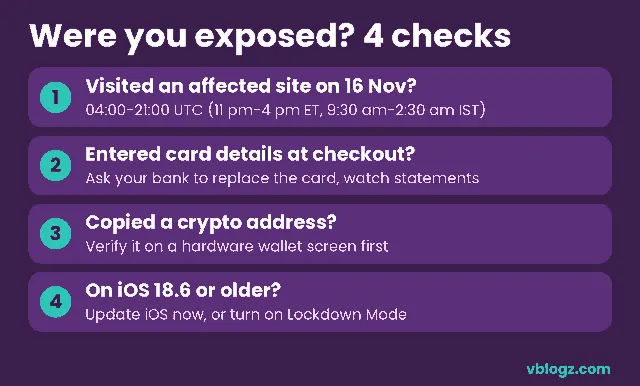
- Window: roughly 04:00 to 21:00 UTC on 16 November (11 pm to 4 pm ET, 04:00 to 21:00 GMT, 9:30 am to 2:30 am IST).
- What it did: swapped crypto wallet addresses, copied card details at checkout, and on some iPhones tried to load exploit kits.
- Your move: replace the card if you paid on an affected site, update iOS, and double-check any crypto address you pasted.
The details below come from security firm StepSecurity's analysis, published on 17 November 2026. Optimizely has called it a security incident involving malware in customers' digital products, as ABC News reported, and Reuters covered the attempt to steal crypto and target iPhone users. Some specifics are still unconfirmed, and I've marked those.
What happened in the Optimizely incident
Optimizely is a tool websites use to run A/B tests. Sites load a script from Optimizely's servers, so whatever sits in that script runs for every visitor. According to StepSecurity, an attacker added a loader to the Project JavaScript field of 178 customer projects on 16 November, and Optimizely's CDN served it to visitors for about 16 hours on most sites.
Optimizely says an account sign-up flaw was exploited and that it has fixed it and removed the injected code. StepSecurity notes that it is still unclear how the attacker got write access across unrelated customer projects. Treat that part as unexplained for now.
What the malicious code did
The analysis describes three behaviours.
- Crypto clipper: when you copied a wallet address, it swapped in the attacker's address if the page text looked like a payment.
- Card skimmer: it captured card number, expiry date and CVV from checkout forms and sent them to the attacker's server.
- iPhone and iPad attacks: for iOS visitors it loaded extra scripts that, per researcher Scott Helme's analysis cited by StepSecurity, use the Coruna and DarkSword exploit kits. StepSecurity did not retrieve those files itself, so this link is not independently confirmed.
StepSecurity reports that the payload server was taken down and the attacker's wallets were emptied by 17 November. Its tally was 188 infected snippets out of 1,611 it checked.
Which sites were affected
StepSecurity lists organisations including CNN, BBC, Fox News, Zoom, Salesforce, GitLab, HSBC and IKEA among those with the code present. Newsweek ran a headline about 178 major websites. I couldn't confirm from the companies themselves which of their pages were affected or whether any customer data was taken, so don't assume you were hit just because you visited one. The risk is real only if you paid or copied a wallet address on an affected page during the window.
Were you exposed? A quick check
The window was about 04:00 to 21:00 UTC on 16 November. In US Eastern Time that's 11 pm on 15 November to 4 pm on 16 November. In India it was 9:30 am to 2:30 am IST the next morning.
What to do now
- If you entered card details on a site that used Optimizely in that window, call your bank and ask for a replacement card. Watch statements for small test charges for the next few weeks.
- If you copied a crypto address in that window, don't send funds until you've compared the full address on your hardware wallet screen, not just the first and last characters.
- Update your iPhone or iPad to the latest iOS. In Settings, go to General, then Software Update.
- If you can't update an older device, turn on Lockdown Mode. Google's threat team said the Coruna kit gives up on devices running it.
- Change passwords on any account you logged into from an affected page, and switch on passkeys where offered. Our Google passkeys guide walks through it.
How the iPhone side works
Coruna was described by Google's threat intelligence team in March 2026. It contains 23 exploits and targets iOS 13.0 through 17.2.1, and Google said the latest iOS isn't affected. StepSecurity goes further and says iOS 18.6 or earlier is most at risk, which is broader than Google's published range. I'd take that as a reason to update, not as proof that a given phone was breached. You can read Google's write-up in its Coruna analysis.
If you were on an old iOS version and visited an affected site in the window, StepSecurity says forensic review may be warranted. For most people the practical step is updating and watching accounts, but anyone holding significant crypto on a phone should treat it more seriously and move funds to a fresh wallet.
If you run a website that uses Optimizely
Check the Project JavaScript field in every Optimizely Web project, including snippets served from your own domain. Review account users and API tokens, search logs back to 04:00 UTC on 16 November, and block the indicators in StepSecurity's post. Moving payment forms into hosted fields from another origin limits what third-party scripts can see. This is the same lesson as the scams we covered recently: attackers go where trust already exists.
Frequently asked questions
Was my data stolen if I visited a site on the list?
Not necessarily. The code only worked if you entered card details or copied a wallet address on an affected page during the window. Merely loading a page is a lower risk, though iPhones on old iOS versions are the exception.
Has Optimizely confirmed the details?
Optimizely has acknowledged a security incident involving malware and says the flaw is fixed. The scale, the iPhone exploit link and the list of affected companies come from outside analysis as of 18 November 2026.
Does Lockdown Mode really help?
For the Coruna kit, yes. Google says it exits when Lockdown Mode is on. It doesn't stop a card skimmer on a checkout page, so it's not a substitute for replacing a card.
Which iOS version should I be on?
The latest one. Google says the newest iOS isn't affected by Coruna, and updating also fixes other known bugs.





Comments 0
No comments yet. Start the conversation.