

On this page 7 sections
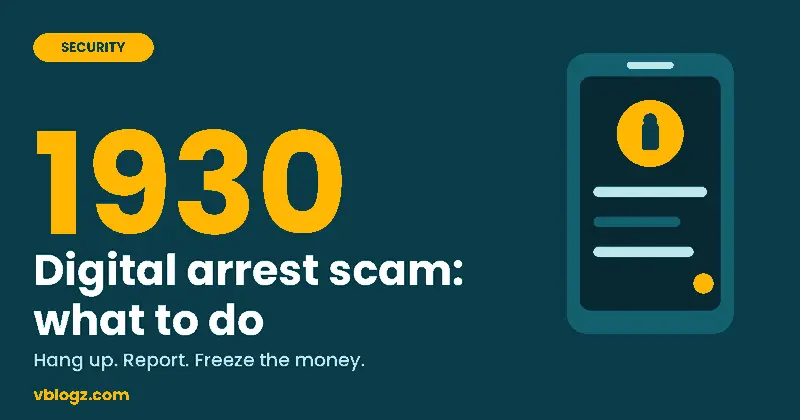
If someone on a phone or video call says they are from the police, CBI or customs and that you are under "digital arrest", hang up. It is a scam. No Indian agency arrests anyone over a video call, and no genuine officer will ask you to transfer money to "clear your name". Call the national cybercrime helpline 1930 or report at cybercrime.gov.in, and do it quickly if you have already paid.
- "Digital arrest" is not a legal process. It is a script scammers use to frighten people.
- The caller keeps you on a video call and tells you not to speak to family or a lawyer.
- Never share OTPs or bank details, and never move money to a "safe" or "verification" account.
- If money has gone, call 1930 first, then your bank, then file an FIR.
What a digital arrest scam is and how it works
A digital arrest scam is a form of impersonation fraud. The caller claims to be from the police, CBI, ED, customs or a telecom regulator and says your name, phone number or Aadhaar is linked to a crime such as money laundering or a parcel full of illegal goods. The goal is simple: scare you into staying on the call and paying.
The pattern is usually the same, as described in coverage of the Supreme Court's directions on these cases and in consumer-finance explainers:
- The first call. It may come from an automated message, a courier "company" or a number that looks official.
- The hand-off. You are passed to a "senior officer", often on WhatsApp or Skype video, with a uniform and an office-style background.
- The paperwork. You receive a fake arrest warrant, court order or ID card as a PDF or photo.
- The isolation. You are told to stay on camera, keep the matter secret and not hang up, sometimes for hours or days.
- The payment. To "verify" your accounts or "prove innocence", you are told to move money to a government-looking account. It never comes back.
Warning signs you can spot in seconds
You do not need to judge whether the uniform looks real. Just check whether the call does any of these things, because real agencies do none of them.
- It threatens arrest right now, over a phone or video call.
- It asks you to stay on the line, keep the camera on or tell nobody.
- It asks for money, OTPs, UPI PINs, card details or screen-sharing access.
- It sends official-looking documents over WhatsApp or email.
- It says you must pay to "clear" your name or move funds to a "safe account".
Even a caller ID that shows a real police number or a government-style name proves nothing. Numbers can be faked.
What to do if you get the call
The fix is to break the script. Scammers depend on you staying calm enough to obey and scared enough not to check.
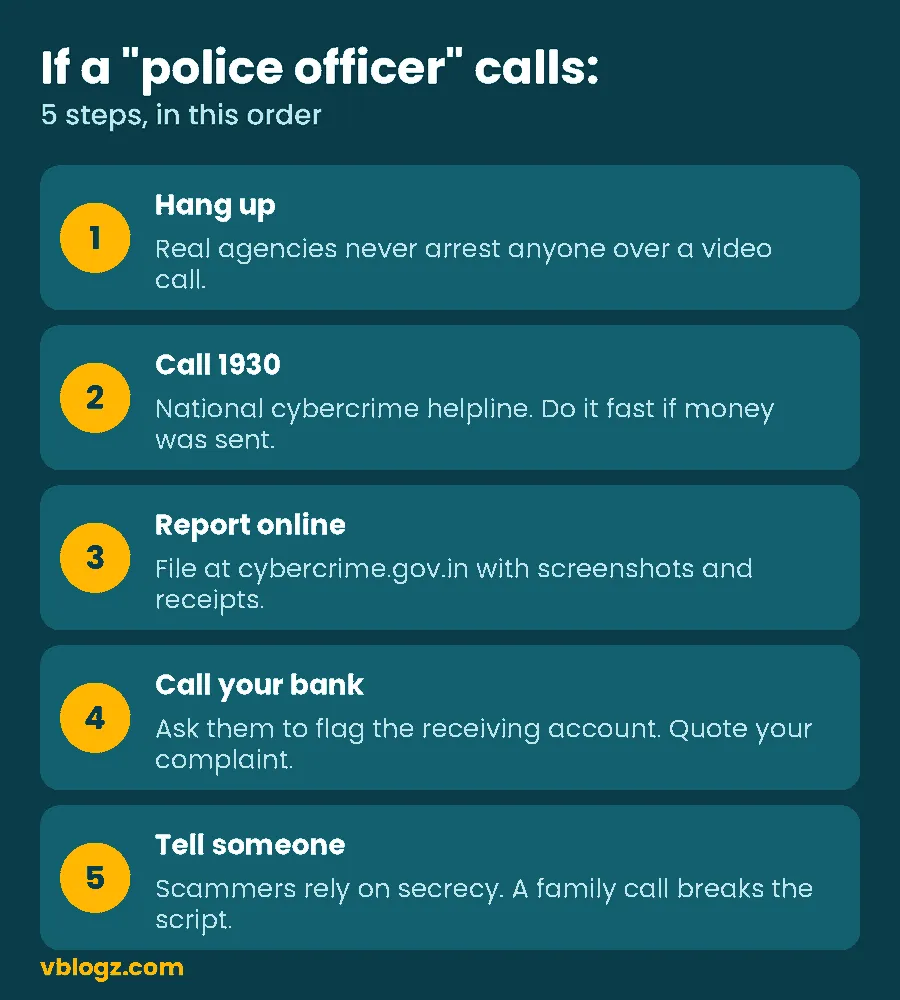
- Hang up. You owe the caller no explanation. Do not argue.
- Call someone you trust. A two-minute talk with a family member or friend usually ends the spell.
- Report the number. Use 1930 or cybercrime.gov.in. You can also flag the number on the government's Sanchar Saathi site or app.
- Do not call back the number or reply to the WhatsApp account.
- Block and screenshot. Save the number, the profile photo and any "documents" before blocking.
If you really are unsure whether a legal notice is genuine, contact the agency using the phone number on its official website, not the number the caller gave you.
What to do if you have already paid
Speed matters. Money moves through several accounts quickly, and banks can only freeze funds that have not yet left.
- Call 1930 immediately and give the transaction details. This is the Citizen Financial Cyber Fraud Reporting System helpline.
- File the same complaint at cybercrime.gov.in and keep the acknowledgement number.
- Call your bank's fraud line and ask them to flag the receiving account, quoting your complaint number.
- File an FIR at your local police station or cybercrime cell, with screenshots, call logs and transaction receipts.
- Change passwords on UPI, banking and email accounts if you shared anything, and remove any screen-sharing app you were told to install.
I cannot promise recovery. Outcomes depend on how fast the money was reported and whether it is still in the receiving account. Reporting also helps police link cases and block the accounts used.
How big is the problem?
During hearings in late 2025, the Supreme Court gave the CBI wide powers to investigate digital arrest cases across states. Reporting on the order said the Union government put losses at about ₹3,000 crore, largely from senior citizens, and that the Indian Cybercrime Coordination Centre (I4C) had blocked over 59,000 WhatsApp accounts linked to the scams as of 2024 (source summary). These are reported figures, and totals change as more cases are filed. The point for you is practical: the scam is common enough that a call like this is far more likely to be fraud than law enforcement.
How to protect older family members
Senior citizens are the most frequent targets, so a short conversation at home helps more than any app.
- Tell them plainly that police and CBI never arrest anyone over a call.
- Agree a rule: nobody sends money or shares an OTP without telling one other family member first.
- Save 1930 in their phone under "Fraud helpline".
- Turn on spam call filtering in the phone app, and secure the accounts that matter. Our guide to setting up passkeys on your Google account covers one useful step.
Scammers also use fear around documents. If a caller mentions Aadhaar or PAN, check things yourself through the official portals. Our guides on checking PAN-Aadhaar link status and spotting online shopping fraud show the genuine routes.
Frequently asked questions
Is digital arrest legal in India?
No. There is no legal process called digital arrest. Police can question or arrest people only through proper legal procedure, and no genuine agency makes you stay on a video call or pay money to avoid arrest.
Where do I report a digital arrest scam?
Call the national cybercrime helpline 1930 or file a complaint at cybercrime.gov.in. You can also report to your local police station or cybercrime cell and inform your bank.
Can I get my money back?
Sometimes, if the money is still in the receiving account when your bank and the cybercrime team act. Report within minutes if you can. Recovery is not guaranteed.
What if the caller already has my Aadhaar or phone number?
That does not make the call real. Scammers buy or leak personal details and quote them to sound convincing. Hang up and report.
Information in this guide is general and was checked in November 2026. Helpline details can change, so confirm them on the official cybercrime portal. This is not legal advice.








Comments 0
No comments yet. Start the conversation.