

On this page 7 sections
Several groups say AI systems have now produced proofs of finite-time blow-up for the Navier-Stokes and Euler equations, and one mathematician at Anthropic says an internal model produced a Lean-only proof of the Generalized Riemann Hypothesis. The headline version is "AI solved a million-dollar maths problem". The accurate version is messier: the claims are real and being taken seriously, but none has been through peer review, and the problem as most people understand it is not settled. This post separates what is documented from what is not, as of 22 November 2026.
The short version
- OpenAI said on 8 September 2026 that an internal model proved a Navier-Stokes blow-up that uses a smooth external force. It says it does not intend to claim the Clay prize.
- On 20 November 2026, Terence Tao wrote that Levent Alpöge and Tristan Buckmaster, "with heavy AI usage", have a proof for the unforced equations, with a Lean formalisation. He also reported a separate Lean-only Generalized Riemann Hypothesis proof by Alpöge.
- Tao did not endorse any of these as verified. He said the Riemann-type proof will take time to digest.
- Anthropic's August paper did not prove the Riemann hypothesis. It raised a bound on zeros on the critical line from 41.6% to 67.2%.
What happened with Navier-Stokes
Navier-Stokes equations describe how fluids such as air and water move. The open question is whether a smooth starting state can ever develop a "singularity", a point where speeds blow up in finite time. It is one of the Clay Mathematics Institute's seven Millennium Prize Problems.
On 8 September 2026, OpenAI published a page claiming a blow-up result for three-dimensional incompressible Navier-Stokes starting from smooth data at rest. The catch is that the construction uses a smooth external force. OpenAI says the work used about 10,000 concurrent agents over roughly 88 hours, and it released a Lean formalisation, a format where a computer checks every logical step.
NPR's coverage, published later in September, reported that the Lean code compiles and that few mathematicians expect it to be wrong. It also reported that the 166-page paper is very hard to read. James Maynard of Oxford said it has been difficult to extract human understanding from it.
Then came the 20 November update. In his blog post, Tao lists a proof of finite-time blow-up for the unforced 3D Euler equations (Alpöge, Buckmaster and Matei Coiculescu) and one for the unforced 3D Navier-Stokes equations (Alpöge and Buckmaster), both with heavy AI assistance and Lean formalisations. He calls the Navier-Stokes paper technically human-readable but says more work is needed to turn it into a professionally written proof.
The Riemann claim, and why it is different
The same post says Alpöge, using an internal AI model, produced a very large proof of the Generalized Riemann Hypothesis that exists only as Lean code. Tao says early analysis suggests it relies on heavy machinery from the Langlands programme and arithmetic geometry, and that digesting it will take time. He does not name which company's model was used.
This is easy to confuse with an earlier result. In August, Anthropic reported that an unreleased Claude version raised the proven share of nontrivial zeta zeros lying on the critical line from 41.6% to 67.2%. Anthropic itself says that is not a proof of the Riemann hypothesis. The November claim is a separate and much bigger one, and it has no human-readable write-up yet.
What's confirmed vs what's still unproven
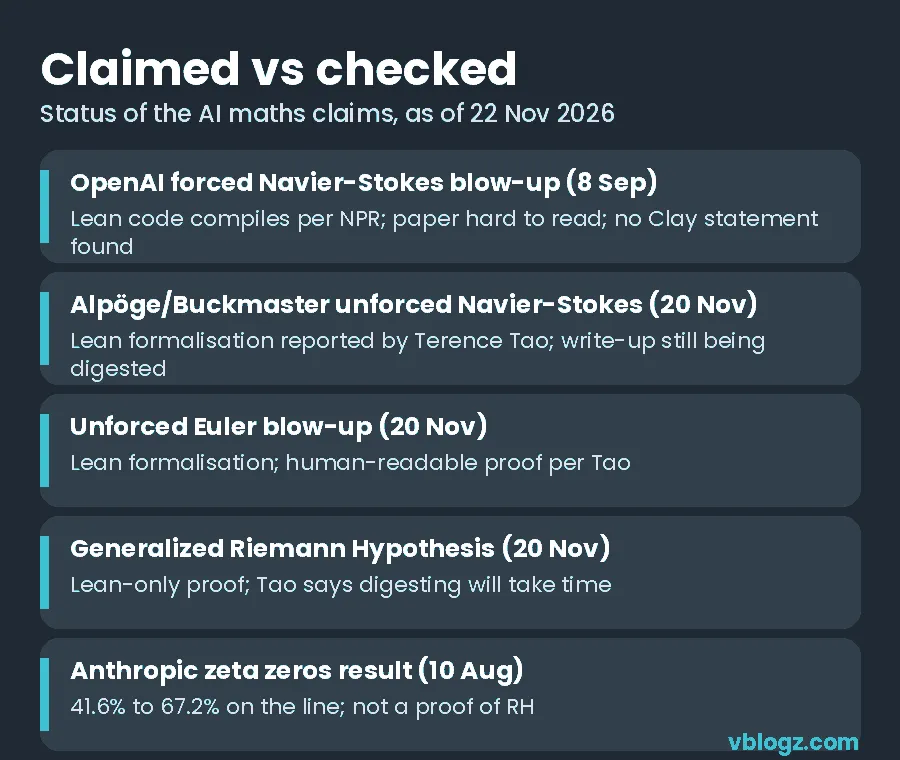
The table below sums up where each claim stands. "Lean formalisation" means a computer checked the logic, which is strong evidence, but a person still has to check that the formal statement matches the problem everyone cares about.
| Claim | Who says so | Status |
|---|---|---|
| Navier-Stokes blow-up with a smooth force | OpenAI, 8 Sep | Lean code compiles per NPR; paper hard to read; no peer review |
| Unforced Navier-Stokes and Euler blow-up | Alpöge, Buckmaster (and Coiculescu), reported by Tao, 20 Nov | Lean formalisations reported; write-up still being improved |
| Generalized Riemann Hypothesis | Alpöge, reported by Tao, 20 Nov | Lean-only; not yet digested by experts |
| Riemann hypothesis itself | No one | Not claimed. Anthropic's August result was a partial bound |
I could not find a statement from the Clay Mathematics Institute on any of these claims, and a Millennium Prize requires publication and a waiting period, so nobody has won anything yet.
The dispute behind the headlines
Not everything is about the maths. NPR reports that Buckmaster says OpenAI learned of the approach he and Alpöge were using, and that OpenAI offered to add him to its paper if he dropped Alpöge. OpenAI denies using their prompts or proofs, and its 10 September update says its investigation found the prompts could not have influenced the system. Those accusations rest on Buckmaster's own account, so treat them as unresolved. NPR also reports that a statement signed by 25 Fields Medal winners criticised misaligned goals between AI companies and mathematicians.
What it means for you
If you do not work in maths, nothing changes in your daily life this week. Fluid simulations in weather and aircraft design already work without knowing whether a singularity can occur. The bigger story is the pattern: AI systems are now producing machine-checkable results that human experts need weeks or months to understand. That flips the usual problem. The risk is no longer "will it be wrong?" but "can anyone read it?".
It also fits a wider trend we have covered, such as OpenAI's AI finding hundreds of Linux kernel bugs, where the question was also how much to trust results at scale. If you are weighing what this means for work, see our look at whether AI is replacing jobs in 2026 and our comparison of the top AI tools.
Frequently asked questions
Has Navier-Stokes been solved?
Not in the sense of a verified, peer-reviewed solution to the Clay problem. There are AI-assisted blow-up proofs with Lean formalisations, but experts are still studying them, and the Clay Institute has not announced a prize.
Did AI prove the Riemann hypothesis?
No. A Generalized Riemann Hypothesis proof was reported on 20 November as Lean-only code, and Terence Tao says it needs time to digest. The ordinary Riemann hypothesis is not claimed as solved.
What does Lean verification actually prove?
It shows every step follows logically from the stated assumptions. It does not show that the formal statement matches the original problem, and that check is done by humans.
Can I read the proofs myself?
The OpenAI paper and Lean code are public, but mathematicians describe the paper as written for machines rather than people. Tao's blog post is the best plain starting point for the November claims.












Comments 0
No comments yet. Start the conversation.