

On this page 8 sections
- What the AQI numbers mean for your health
- GRAP stages: what changes when AQI rises (Delhi-NCR)
- Masks: which ones actually protect you
- Air purifiers: when they're worth it and how to choose
- Everyday habits that cut your exposure
- What doesn't really help
- When to see a doctor
- Frequently asked questions
To protect yourself from air pollution, do three things: check the AQI before going out, wear a well-fitted N95 or FFP2 mask when it's "Poor" or worse, and keep one room at home clean with a HEPA air purifier and closed windows. Everything else helps less than you'd think.
From late October, air quality across north India usually drops sharply as winds slow, temperatures fall and pollution gets trapped near the ground. Here is how to read the AQI, what actually reduces your exposure, and what doesn't.
What the AQI numbers mean for your health
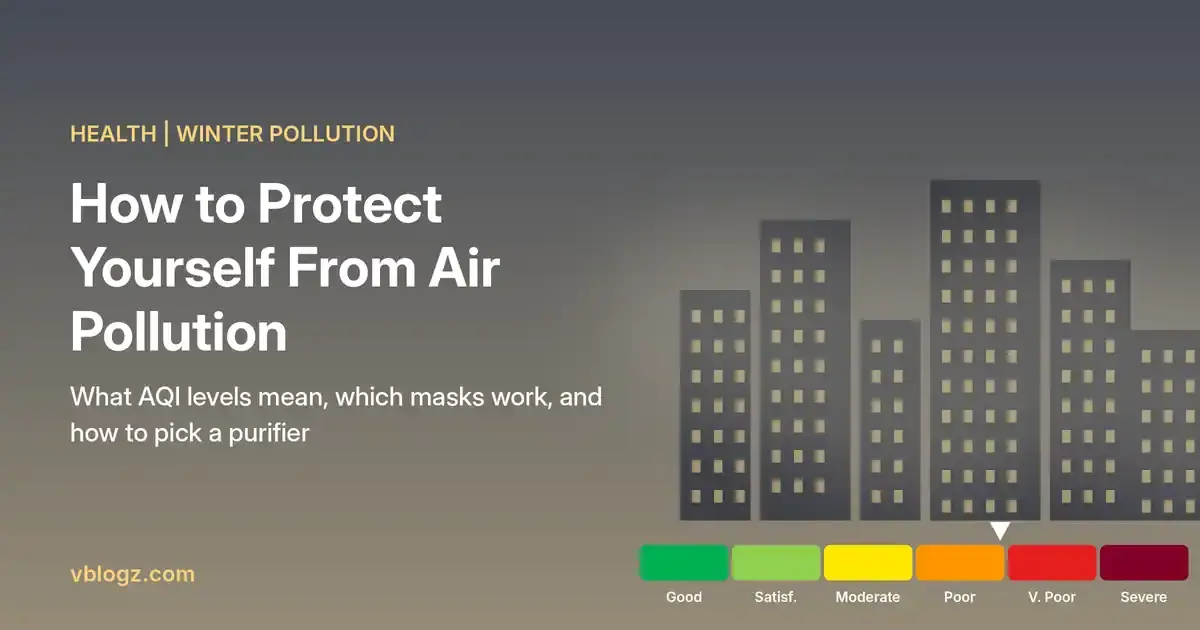
India's National Air Quality Index, run by the Central Pollution Control Board (CPCB), has six bands. The health notes below follow CPCB's own descriptions.
| AQI | Category | Possible health impact |
|---|---|---|
| 0-50 | Good | Minimal impact |
| 51-100 | Satisfactory | Minor breathing discomfort for sensitive people |
| 101-200 | Moderate | Breathing discomfort for people with asthma or lung disease, and discomfort for people with heart disease, children and older adults |
| 201-300 | Poor | Breathing discomfort for most people on prolonged exposure |
| 301-400 | Very Poor | Respiratory illness on prolonged exposure |
| 401-500 | Severe | Affects healthy people and seriously affects those with existing diseases |
The main culprit in winter is PM2.5, particles small enough to go deep into the lungs and into the bloodstream. For scale, the WHO global air quality guidelines recommend that 24-hour PM2.5 levels stay below 15 µg/m³. India's own 24-hour standard is 60 µg/m³. On a "Severe" day in Delhi, readings can be many times higher than both.
You can check live AQI for your city on CPCB's SAMEER app or the CPCB AQI portal. Look at the station closest to you, not just the city average.
GRAP stages: what changes when AQI rises (Delhi-NCR)
In Delhi-NCR, the Commission for Air Quality Management (CAQM) triggers the Graded Response Action Plan (GRAP) as pollution worsens:
- Stage I: AQI 201-300 (Poor)
- Stage II: AQI 301-400 (Very Poor)
- Stage III: AQI 401-450 (Severe)
- Stage IV: AQI above 450 (Severe+)
Each stage adds restrictions on construction, diesel generators, older vehicles and, at the higher stages, school and office arrangements. The rules are revised from time to time, so check CAQM's latest order rather than last year's news when planning your week.
Masks: which ones actually protect you
Yes, a mask protects you from air pollution, but only the right kind, worn the right way.
- N95 (or the European FFP2): designed to filter at least 95% of fine particles. This is what you want on "Poor" days and above.
- Surgical masks and cloth masks: built to stop droplets, not fine smoke particles. They leave gaps at the sides and let much of the PM2.5 through.
- Fit is everything: an N95 that leaks around the nose is not doing its job. Press the metal strip to your nose and check that air doesn't escape around the edges when you breathe out hard.
- Valved masks are easier to breathe in. The valve only affects the air you breathe out, so they still protect you.
- Replace the mask when it gets dirty, damaged or harder to breathe through. Don't wash an N95.
Children's faces are smaller, so adult N95s rarely fit them well. Look for masks sized for kids, and remember that for young children, keeping them indoors on bad days works better than a badly fitted mask.
Air purifiers: when they're worth it and how to choose
An air purifier with a true HEPA filter can bring indoor PM2.5 down a lot, if the room is closed and the purifier is sized for it.
- Check the CADR (clean air delivery rate). Higher CADR cleans a room faster. Match it to your room size, and pick a bigger rating than the minimum for Delhi-level pollution.
- Run it in the room you spend the most time in, usually the bedroom. One clean room is better than three half-clean ones.
- Keep doors and windows closed while it runs. A purifier can't keep up with an open window.
- Replace the filter on time. A clogged filter keeps the fan running but stops cleaning.
- Skip ionisers and "ozone" features. Ozone irritates the lungs. A plain HEPA purifier is enough.
Can't afford a purifier? Keep windows shut during the worst hours, seal obvious gaps with tape or draught strips, and avoid adding indoor smoke.
Everyday habits that cut your exposure
- Time your outdoor exercise. On winter days, pollution is often worst in the early morning and late evening when the air near the ground is still. If you run or walk, check the AQI and move indoors on "Very Poor" and "Severe" days.
- Don't add indoor pollution. Incense sticks, mosquito coils, frying with smoking oil and burning anything indoors all raise PM2.5 at home. Use an exhaust fan or chimney when cooking.
- Travel smart. Keep car windows closed and set the AC to recirculation in heavy traffic. Avoid walking along busy roads where possible.
- Keep medicines ready. If you have asthma or COPD, make sure your inhalers are in date and follow your doctor's action plan. Winter is when flare-ups rise.
- Watch the vulnerable. Children, older adults, pregnant women and people with heart or lung disease feel the effects first.
What doesn't really help
- "Detox" foods and drinks: no food or kadha clears pollution out of your lungs. A balanced diet is good for you, but it isn't a shield.
- Indoor plants as air purifiers: plants are nice to have, but you'd need an impractical number of them to match even a small purifier.
- Steam inhalation to "clean" the lungs: it may ease a blocked nose, but it doesn't remove particles from your lungs.
When to see a doctor
See a doctor if you have breathlessness that doesn't settle with rest, chest tightness or pain, wheezing, a cough lasting more than two to three weeks, or if your usual inhaler isn't working as well. Seek urgent care for severe breathlessness, lips turning bluish, or confusion. Older people with heart disease should report new chest discomfort straight away.
Pollution season often overlaps with dengue in north India. If you have a high fever, read our guide to dengue symptoms and warning signs.
Frequently asked questions
Does wearing a mask protect you from air pollution?
A well-fitted N95 or FFP2 mask filters most fine particles, including PM2.5. Surgical and cloth masks give little protection against pollution because they let fine particles through and leak at the sides.
What AQI is safe for outdoor exercise?
Up to "Satisfactory" (AQI 100) is fine for most people. In the "Moderate" band, people with asthma, heart disease, children and older adults should cut back. At "Poor" and above, move workouts indoors.
Do air purifiers really work?
Yes, a HEPA purifier sized for the room can sharply reduce indoor PM2.5, as long as doors and windows stay closed and the filter is replaced on time.
What is the most harmful pollutant in winter?
PM2.5. These fine particles go deep into the lungs and are linked to heart and lung disease. They're usually the main driver of "Very Poor" and "Severe" AQI days.








Comments 0
No comments yet. Start the conversation.