

On this page 7 sections
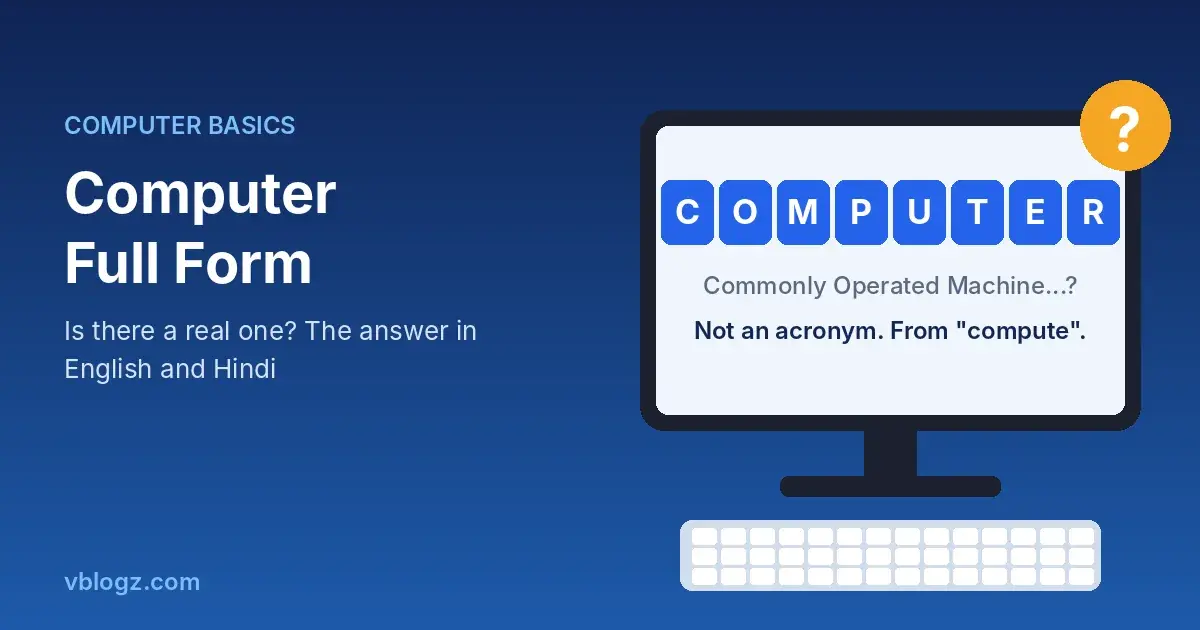
Computer has no official full form. It's an ordinary English word that comes from "compute", meaning to calculate. The expansion you see on school charts and WhatsApp forwards, "Commonly Operated Machine Particularly Used for Technical, Education and Research", was made up later to fit the letters. That kind of invented expansion is called a backronym.
That said, the backronym does show up in school worksheets and a few quiz books, so it helps to know both: the popular answer, and the true one. Here are both, plus the Hindi word for computer and the full forms of the short words you'll see next to it, like CPU and PC.
The computer full form most charts use
If a teacher or a worksheet asks "What is the full form of COMPUTER?", this is the answer they usually expect. It's the same one printed in most class 1 to class 8 computer books and GK charts:
| Letter | Word |
|---|---|
| C | Commonly |
| O | Operated |
| M | Machine |
| P | Particularly |
| U | Used for |
| T | Technical |
| E | Education and |
| R | Research |
You'll also find versions like "Common Operating Machine Purposely Used for Technological and Educational Research". The wording changes from site to site, which is a clue in itself: a real acronym has one fixed expansion. No dictionary, computer maker or standards body uses either version.
So what should you write? In a school test that clearly expects the chart answer, write it. In anything that asks where the word comes from, or in an interview, say that computer is not an acronym and explain the origin below. That answer is correct everywhere.
Where the word "computer" really comes from
"Compute" comes from the Latin computare, to count or reckon. The earliest known use of "computer" in English is from 1613, in Richard Braithwaite's book The Yong Mans Gleanings, and it meant a person, not a machine: someone who did calculations by hand (Centre for Computing History).
That meaning lasted a surprisingly long time. Into the 1950s and 60s, observatories, armies and NASA employed teams of human "computers" to work out tables and trajectories. As electronic machines took over that job, the name moved to the machines.
Today a computer is defined as an electronic machine that takes input, processes it by following a set of instructions (a program), stores data and gives output. That input, process, output and storage cycle is the definition most textbooks use.
Computer full form in Hindi and its Hindi name
Since computer isn't an acronym in English, it has no Hindi full form either. When people search "computer ka full form", the honest answer is: computer ka koi official full form nahi hai. It's a word, not short for anything.
The standard Hindi word for computer is संगणक (sanganak), from the same idea of calculating. You'll see it in government glossaries and some textbooks, though in everyday Hindi people just say "computer". If a Hindi-medium worksheet asks for the full form, it expects the same chart answer from the table above, written in English.
Full forms you'll see next to "computer"
Most "computer full form" questions are really about these short forms. Unlike COMPUTER, these are real abbreviations with one correct expansion.
| Short form | Full form | What it is |
|---|---|---|
| PC | Personal Computer | A desktop or laptop for one person |
| CPU | Central Processing Unit | The main processor that runs instructions |
| RAM | Random Access Memory | Working memory, cleared when power goes off |
| ROM | Read Only Memory | Permanent memory with startup code |
| UPS | Uninterruptible Power Supply | Battery backup during power cuts |
| SMPS | Switched-Mode Power Supply | The power supply inside the cabinet |
| HDD | Hard Disk Drive | Spinning-disk storage |
| SSD | Solid State Drive | Faster storage with no moving parts |
| OS | Operating System | Windows, Linux, macOS, Android |
| USB | Universal Serial Bus | Port for pen drives, keyboards, chargers |
For 146 more, sorted by topic, see our computer full forms list.
Does internet have a full form?
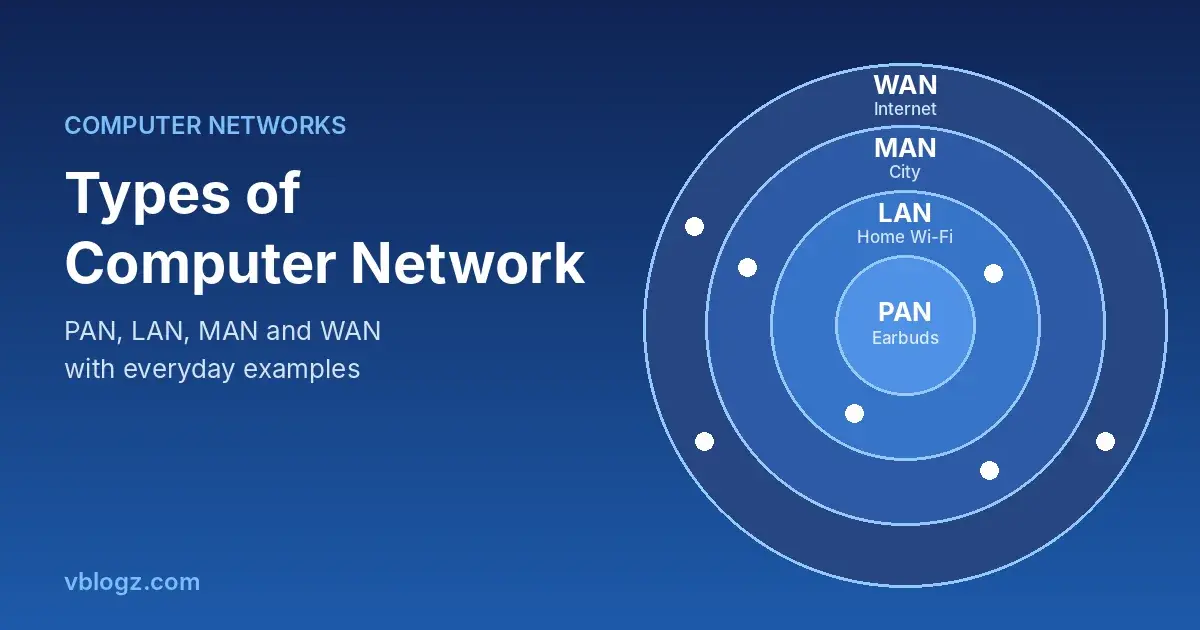
Not officially either. "Internet" is short for internetwork, a network made by connecting many networks together. Exam guides often give "Interconnected Network" or "International Network". Interconnected Network is the closer description of what the internet is, but neither is an official expansion. The internet is also the biggest example of a WAN, which we explain in types of computer network.
Other words that look like acronyms but aren't
- Wi-Fi: a brand name. "Wireless Fidelity" was a slogan added after the name was chosen.
- Mobile and phone: ordinary words. "Mobile" means movable, and "phone" is short for telephone. More in our mobile phone full forms guide.
- Byte, email and Bluetooth: a unit name, a shortened word (electronic mail) and a name taken from a Danish king.
Frequently asked questions
What is the full form of computer in English?
Computer has no official full form. The answer commonly taught in schools is "Commonly Operated Machine Particularly Used for Technical, Education and Research", but that expansion was invented after the word already existed.
What is computer ka full form in Hindi?
There isn't one, because computer isn't an acronym. Its Hindi name is संगणक (sanganak). Hindi-medium worksheets that ask for a full form usually expect the English chart answer.
What is the computer full form for class 1 to class 8?
School books for class 1 to 8 use the chart answer: Commonly Operated Machine Particularly Used for Technical, Education and Research. Write that in a school test, and remember it's a memory aid, not the word's real origin.
What is the definition of a computer?
A computer is an electronic machine that accepts input, processes it according to a program, stores data and produces output.
Who is called the father of the computer?
Charles Babbage, an English mathematician, is usually called the father of the computer. In the 1830s he designed the Analytical Engine, a mechanical machine with the basic parts a modern computer has: memory, a processing unit and input and output.
What is the full form of PC?
PC stands for Personal Computer, a computer meant to be used by one person at a time, such as a desktop or a laptop.




Comments 0
No comments yet. Start the conversation.