

On this page 9 sections
- Why sweets get adulterated around Diwali
- Home tests that actually work
- Checks that sound good but don't prove much
- Read the label, even on loose sweets
- Silver varq: what the rules say
- Colour: brighter is not better
- Smart buying checklist for Diwali sweets
- What to do if you find adulterated sweets
- Frequently asked questions
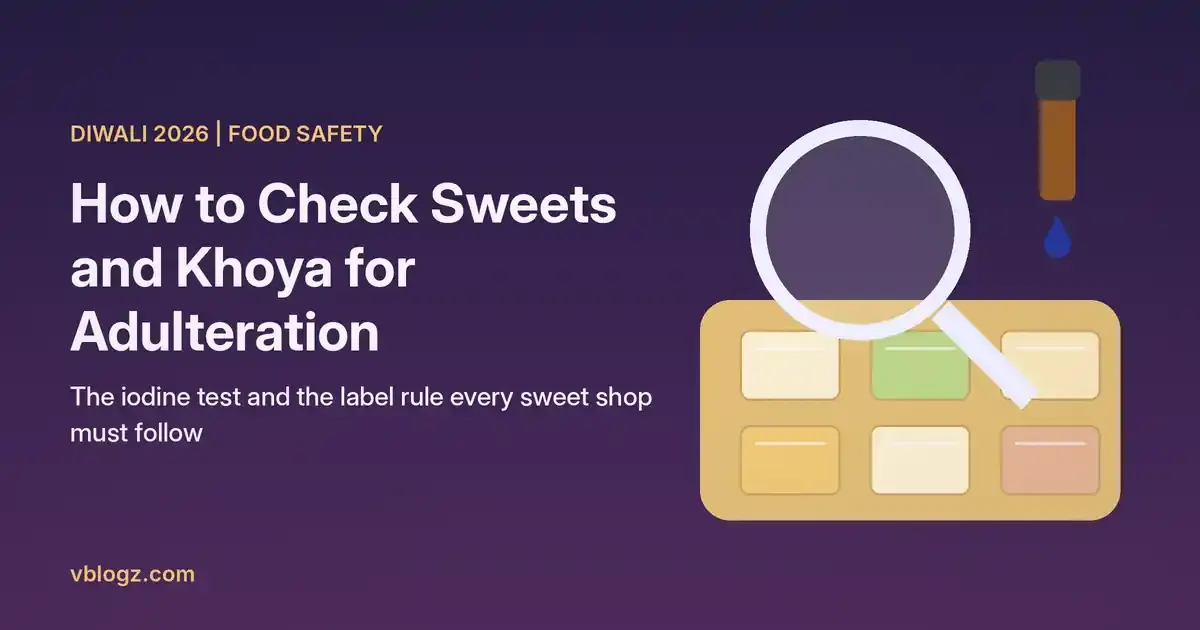
The quickest home check for khoya, paneer or milk sweets is the iodine test: boil a small piece in water, let it cool, add a few drops of iodine tincture, and watch for a blue or blue-black colour. Blue means starch has been added. That one test, plus reading the best-before date on the shop's tray, catches more bad mithai than any trick you'll find on social media.
Diwali falls on Sunday, 8 November 2026, with Dhanteras on 6 November. Demand for khoya and milk sweets peaks in the two weeks before, and that is when adulteration peaks too. Here is what you can check at home, what you can't, and what to do when something seems off.
Why sweets get adulterated around Diwali
Khoya is made by slowly boiling milk down until most of the water is gone. It takes several litres of milk to make one kilo, and that milk costs money. When demand jumps, some sellers stretch khoya with cheaper fillers like starch or skimmed milk powder, or sell old stock mixed with fresh. Bright mithai can also carry more synthetic colour than the law allows.
Most sweet shops are honest. The point of the checks below is not paranoia, it's to make sure what you're paying for is what's on the label.
Home tests that actually work
1. Iodine test for starch in khoya, paneer and chhena
This is the test recommended by FSSAI's Food Safety Helpline, and it is the most reliable one you can do in a kitchen.
- Take about a teaspoon of khoya, paneer or the sweet's base.
- Boil it in a little water for a couple of minutes.
- Let it cool completely.
- Add 2-3 drops of iodine tincture (sold at chemists).
Result: a blue or blue-black colour means starch is present. Pure khoya stays the brownish-yellow colour of the iodine.
One caution: some sweets legitimately contain flour, like besan laddoo, or sweets thickened with arrowroot. Test the milk-based ones (barfi, peda, kalakand, milk cake), not the ones where flour is an ingredient.
2. Water test for milk
If you make sweets at home, check the milk first. Put a drop on a clean, slanting surface such as a steel plate. Pure milk slides slowly and leaves a white trail. Milk with added water runs down quickly and leaves almost no mark.
3. Detergent test for milk
Shake 5-10 ml of milk with the same amount of water in a bottle. A thick, lasting lather suggests detergent. Normal milk gives only a thin froth that settles quickly.
4. Smell, taste and texture
Fresh khoya smells milky and slightly sweet and feels smooth, a little oily. Sour smell, a rubbery or gritty texture, or a stale aftertaste means it's old or poorly made. This won't prove adulteration, but it's often your first clue.
Checks that sound good but don't prove much
- "Rub it on your palm, real khoya leaves ghee": some fat on your hand only tells you there is fat, not whether it's milk fat or vegetable fat.
- Burning a piece of khoya: the flame and smell vary with moisture and sugar. It's not a test you can read with any confidence.
- Testing silver varq at home: videos claim you can spot aluminium by rubbing or burning the leaf. Results depend on how thin the leaf is and are easy to misread. If you're unsure about a shop's varq, buy sweets without it.
Home tests can only flag obvious problems. If you suspect something serious, a food lab test is the only reliable answer.
Read the label, even on loose sweets
Since 1 October 2020, FSSAI has required sweet shops to display a "best before" date on the tray or container of loose, unpackaged sweets, as explained by S.S. Rana & Co.. The manufacturing date is optional, but the best-before date is not.
- No date on the tray? Ask. A good shop will tell you when the batch was made.
- Milk sweets like rasgulla, kalakand and malai-based sweets spoil fastest. Buy them close to when you'll serve them.
- Dry sweets like soan papdi, besan laddoo and kaju katli last longer, which makes them a safer pick for gifting.
- Packaged boxes must carry the FSSAI licence number, ingredients and dates. Check the date before you pay, not when you get home.
Silver varq: what the rules say
FSSAI's standard for edible silver leaf requires silver of at least 999/1000 purity, a weight of no more than 2.8 g per square metre, and no use of animal-origin material at any stage of manufacture, according to an FSSAI note on silver leaf. Leaf that doesn't meet this, including aluminium foil passed off as silver, is not allowed on food.
Since you can't verify this at home, the practical rule is simple: buy varq sweets only from shops you trust, and skip the decoration if in doubt. The sweet tastes the same without it.
Colour: brighter is not better
Only approved food colours are allowed in sweets, and only in small amounts. A jalebi or laddoo in neon orange, or barfi in an electric green, is a sign of a heavy hand with colour, or worse, non-food dyes. Pick sweets with natural-looking colours: the pale cream of milk barfi, the light gold of besan, the green of real pista.
Smart buying checklist for Diwali sweets
- Buy from busy, licensed shops with high turnover, so stock doesn't sit for days.
- Check the best-before date on the tray or box.
- Prefer dry sweets for gifts that will travel or sit for a few days.
- Buy milk sweets in small quantities and refrigerate them.
- Avoid very bright colours and suspiciously cheap khoya.
- If you make sweets at home, buy khoya a day before, and do the iodine test.
What to do if you find adulterated sweets
Keep the sweet and the bill. You can file a complaint with your state's food safety department or through FSSAI's Food Safety Connect app. Name the shop, the product and the date of purchase. If someone fell ill after eating it, see a doctor first and keep the medical papers.
Festive seasons bring more than food risks. Before you shop online for gifts, read our guide on how to spot festive sale scams. And if you're fasting this month, check our Navratri vrat food list for buying kuttu atta safely.
Frequently asked questions
How to check purity of khoya at home?
Boil a small piece in water, cool it and add a few drops of iodine tincture. A blue or blue-black colour means starch has been mixed in. Also check smell and texture: fresh khoya smells milky and feels smooth.
What are adulterated sweets?
Sweets that contain cheaper fillers, non-permitted colours or spoiled ingredients in place of what they claim to be made of. Common examples are starch in khoya, excess or non-food colours, and fake silver varq.
How long do milk sweets last?
It depends on the sweet and how it's stored. Shops must display a best-before date on loose sweets, so follow that. Milk-heavy sweets like rasgulla and kalakand spoil fastest and should be refrigerated.
Is silver varq safe to eat?
Varq that meets FSSAI's standard of pure silver and no animal-origin material is permitted on food. The risk is substandard leaf, so buy from shops you trust or choose sweets without varq.







Comments 0
No comments yet. Start the conversation.