

On this page 13 sections
- Quick list: Diwali sweets names, time and shelf life
- 1. Coconut ladoo (15 minutes)
- 2. Milk powder barfi (15 minutes plus setting)
- 3. Dry fruit ladoo with no added sugar (20 minutes)
- 4. Besan ladoo (35-40 minutes)
- 5. Rava ladoo (25 minutes)
- 6. Kaju katli (30 minutes)
- 7. Quick kalakand (25 minutes plus setting)
- 8. Shakarpara (45 minutes)
- Make-ahead plan for Diwali 2026
- How long do Diwali sweets last?
- How to pack Diwali sweets as gifts
- Frequently asked questions
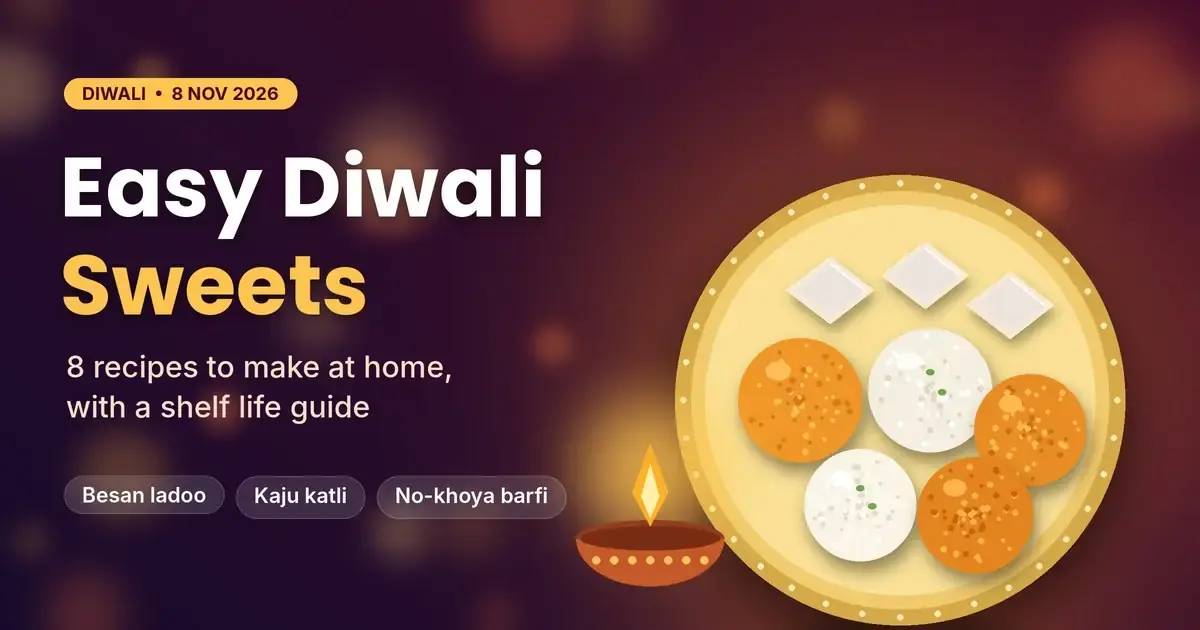
The easiest Diwali sweets to make at home are coconut ladoo, milk powder barfi, besan ladoo, kaju katli and dry fruit ladoo. None of them needs a sugar thermometer or khoya from the market, and most are done in under 40 minutes. Diwali falls on Sunday, 8 November 2026, so you have time to make the long-lasting ones this weekend and the milky ones a day or two before.
Below are eight beginner-friendly Diwali sweets recipes with exact quantities, the one mistake to avoid in each, a shelf life table, and a simple make-ahead plan so nothing goes stale before Lakshmi Puja.
Quick list: Diwali sweets names, time and shelf life
| Sweet | Total time | Difficulty | Keeps for (approx.) |
|---|---|---|---|
| Coconut ladoo | 15 min | Very easy | 5-7 days in the fridge |
| Milk powder barfi | 15 min + setting | Very easy | 5-6 days in the fridge |
| Dry fruit ladoo (no sugar) | 20 min | Very easy | 2-3 weeks |
| Besan ladoo | 35-40 min | Easy | 10-15 days |
| Rava ladoo | 25 min | Easy | 7-10 days |
| Kaju katli | 30 min | Medium | 7-10 days |
| Quick kalakand | 25 min + setting | Easy | 2-3 days in the fridge |
| Shakarpara | 45 min | Easy | 2-3 weeks |
Shelf life depends on how much moisture a sweet has, how clean your hands and containers are, and the weather. Treat these as a rough guide and always store in airtight boxes. A standard measuring cup here is about 240 ml.
1. Coconut ladoo (15 minutes)
If you've never made a sweet before, start here. It's nearly impossible to get wrong.
You need: 2 cups desiccated coconut, 200 g sweetened condensed milk (about half a 400 g tin), 1 tbsp ghee, ¼ tsp cardamom powder, a few chopped pistachios.
- Heat ghee in a heavy kadhai on low. Add the coconut and roast for 2 minutes, just until it smells toasty. Don't let it brown.
- Pour in the condensed milk and stir continuously for 5-6 minutes.
- When the mixture comes together in one mass and leaves the sides, switch off the heat and add cardamom.
- Let it cool until you can handle it, then grease your palms and roll into lemon-sized balls. Roll each one in a little extra coconut and top with pistachio.
Makes: about 15. Common mistake: over-cooking. If you cook it too long it turns dry and won't hold. Take it off as soon as it gathers into a ball.
2. Milk powder barfi (15 minutes plus setting)
This tastes close to a khoya barfi but uses milk powder you probably already have.
You need: 2 cups milk powder, ½ cup milk, ¼ cup ghee, ½ cup sugar, ¼ tsp cardamom powder, sliced almonds.
- Grease a small tray or steel plate.
- Melt ghee in a non-stick pan on low. Add milk and sugar and stir until the sugar dissolves.
- Add the milk powder a little at a time, whisking to break lumps.
- Keep stirring on low for 5-7 minutes until it thickens into a soft dough that pulls away from the pan.
- Add cardamom, spread in the tray, press almonds on top and leave to set for 1-2 hours. Cut into squares.
Makes: about 16 pieces. Common mistake: high heat. Milk powder burns in seconds, so keep the flame low the whole time.
3. Dry fruit ladoo with no added sugar (20 minutes)
Good for diabetic relatives to have as an option, though dates are still high in natural sugar, so portion size matters. No cooking skill needed.
You need: 1 cup seedless dates (about 15-18 soft dates), ½ cup almonds, ½ cup cashews, ¼ cup walnuts, 2 tbsp pumpkin or melon seeds, 1 tsp ghee, 2 tbsp desiccated coconut or poppy seeds for coating.
- Dry roast the nuts and seeds on low for 4-5 minutes until fragrant. Cool, then pulse in a mixer to a coarse crumb. Don't make it powder.
- Blend the dates into a sticky paste. If they're hard, soak them in warm water for 15 minutes first and pat dry.
- Warm the ghee in a pan, add the date paste and stir for 2-3 minutes until soft.
- Mix in the nuts, cool slightly, and roll into small balls. Coat in coconut or poppy seeds.
Makes: about 18 small ladoos.
4. Besan ladoo (35-40 minutes)
The classic. It takes patience more than skill, because the besan needs slow roasting to lose its raw taste.
You need: 2 cups besan (about 200 g, coarse besan gives a better texture), ½ cup ghee, ¾ to 1 cup powdered sugar or bura, ¼ tsp cardamom powder, 2 tbsp chopped almonds or cashews.
- Melt ghee in a heavy kadhai on low. Add besan and stir.
- Roast on the lowest flame for 20-25 minutes, stirring all the time. It will first look dry and lumpy, then loosen and turn smooth.
- It's ready when it turns golden, smells nutty and you see ghee separating at the edges.
- Take it off the heat and spread it on a plate to cool for 15-20 minutes. It should be warm, not hot.
- Mix in sugar, cardamom and nuts, then press into tight balls with your palms.
Makes: 14-16. Common mistake: adding sugar while the besan is still hot. The sugar melts and the ladoos go flat and sticky. If the mixture is too dry to bind, add a teaspoon of melted ghee.
5. Rava ladoo (25 minutes)
You need: 1 cup fine rava (sooji), ½ cup desiccated coconut, ¼ cup ghee, ¾ cup powdered sugar, 2-3 tbsp warm milk, 10 cashews, 10 raisins, ¼ tsp cardamom.
- Fry the cashews and raisins in a spoon of the ghee and set aside.
- Add the rest of the ghee and roast rava on low for 8-10 minutes until it smells fragrant and turns very light golden.
- Add coconut and roast for 2 more minutes. Turn off the heat.
- Stir in powdered sugar, cardamom and the fried nuts.
- Sprinkle the warm milk a spoon at a time and shape into ladoos while the mix is still warm.
Makes: about 12. Ladoos made with milk don't last as long as besan ladoo, so finish these within a week or keep them in the fridge.
6. Kaju katli (30 minutes)
The most gifted Diwali sweet, and easier at home than people expect once you know the texture to look for.
You need: 1 cup cashews (about 150 g), ½ cup sugar, ¼ cup water, 1 tsp ghee, a pinch of cardamom (optional), silver vark (optional).
- Grind the cashews to a fine powder in short pulses. Long runs release oil and make the paste greasy. Sieve it.
- In a non-stick pan, heat sugar and water until the sugar dissolves and the syrup bubbles for a minute.
- Turn the flame to low and add the cashew powder. Stir continuously for 5-8 minutes.
- Test a small piece: once cool, it should roll into a smooth ball that doesn't stick. That's when it's done.
- Transfer to a greased plate, add ghee and knead gently while warm until smooth.
- Roll between two sheets of butter paper to about 5 mm thickness, apply vark if using, and cut into diamonds.
Makes: about 20 pieces. Common mistake: over-cooking. If it turns crumbly when you knead, add a teaspoon of warm milk and knead again. If it's too sticky, cook it for another minute.
7. Quick kalakand (25 minutes plus setting)
You need: 250 g fresh paneer, crumbled finely, 200 g condensed milk, ¼ tsp cardamom powder, chopped pistachios.
- Mash the paneer with your palm until it's fine and slightly smooth.
- Cook paneer and condensed milk together in a non-stick pan on low for 10-12 minutes, stirring often.
- When it thickens and starts leaving the sides, add cardamom.
- Spread in a greased tray, top with pistachios and chill for 2-3 hours before cutting.
Make kalakand last. It's the most perishable sweet on this list, so prepare it on 7 November and keep it refrigerated.
8. Shakarpara (45 minutes)
A crunchy, sugar-coated snack that's ideal for gift boxes because it lasts for weeks.
You need: 2 cups maida, ¼ cup melted ghee, ½ cup sugar, ½ cup milk, a pinch of salt, oil for frying.
- Warm the milk and dissolve the sugar in it. Let it cool.
- Rub the ghee into the maida with salt until it looks like breadcrumbs.
- Knead with the sweet milk into a firm dough. Rest it covered for 20 minutes.
- Roll out thick, about 6-7 mm, and cut into small diamonds.
- Fry on low-medium heat until golden and crisp, about 8-10 minutes per batch. Drain and cool fully before storing.
Common mistake: frying on high heat. They brown outside but stay soft inside and go chewy within a day.
Make-ahead plan for Diwali 2026
Here's a simple order so everything is fresh on 8 November:
- 31 October to 2 November: shakarpara and dry fruit ladoo (they last the longest).
- 3 to 4 November: besan ladoo.
- 5 November (Dhanteras week): kaju katli and rava ladoo.
- 6 to 7 November: coconut ladoo, milk powder barfi and kalakand. Keep these in the fridge.
How long do Diwali sweets last?
The simple rule: the more milk and moisture, the shorter the life.
- Dry, ghee-based sweets like besan ladoo, shakarpara and dry fruit ladoo keep for 10 days to a few weeks at room temperature in an airtight box.
- Cashew sweets like kaju katli are good for about a week, a little longer in the fridge.
- Milk, paneer and condensed milk sweets like kalakand, barfi and coconut ladoo should go in the fridge and be eaten within a few days.
Throw out anything that smells sour, feels slimy or shows spots of mould, even if it's within these dates.
When buying from a shop, don't rely on a label alone. FSSAI made a "best before" date compulsory on trays of loose sweets in 2020, but in November 2023 it changed that to voluntary, according to Food Safety Works. So many shops no longer display one. Ask when the batch was made. For quick home checks on khoya and silver vark, see our guide on how to check sweets and khoya for adulteration.
How to pack Diwali sweets as gifts
- Cool everything completely before packing. Warm sweets sweat and spoil faster.
- Put each sweet in its own paper cup or separate them with butter paper, so flavours and oils don't mix.
- Pack dry sweets (shakarpara, dry fruit ladoo) in one box and milk sweets in another, and tell people to refrigerate the milky ones.
- Steel dabbas, glass jars and cardboard mithai boxes with a butter paper lining all work. Avoid closing warm sweets in plastic.
- Add a small handwritten note with the sweet's name and "eat by" date. Relatives appreciate it.
If you enjoy cooking for festivals, our Navratri vrat food list has ideas you can reuse for fasting days too.
Frequently asked questions
What are the easiest Diwali sweets for beginners?
Coconut ladoo and milk powder barfi are the easiest, both ready in about 15 minutes with just a few ingredients. Dry fruit ladoo is also simple because it needs almost no cooking. Besan ladoo takes longer but only asks you to keep stirring on low heat.
Which Diwali sweets can be made a week in advance?
Besan ladoo, shakarpara and dry fruit ladoo can all be made a week or more in advance if stored airtight. Kaju katli can be made about five days ahead. Leave milk-based sweets like kalakand and barfi until the last two days.
What are traditional Diwali sweets?
Common traditional Diwali sweets include besan ladoo, kaju katli, gulab jamun, kalakand, soan papdi, barfi and jalebi in the north, and mysore pak, adhirasam and karanji in the south and west. Most families also make a savoury item like chakli or mathri.
How do I make Diwali sweets without khoya?
Use milk powder or condensed milk instead. Milk powder barfi and quick kalakand made with paneer and condensed milk both give a similar rich taste without hunting for khoya, which is often the most adulterated ingredient during festival season.
When is Diwali in 2026?
Diwali 2026 is on Sunday, 8 November, with Lakshmi Puja in the evening. Exact muhurat timings vary by city, so check your local panchang.




Comments 0
No comments yet. Start the conversation.